
7 Signs You May Need Root Canal Treatment (RCT) in Prayagraj
When is tooth pain more than a small cavity? Learn the warning signs, when you need urgent care, and how a dentist decides whether a natural tooth can be saved.
Understanding the problem
Is your tooth trying to tell you something?
A painful tooth can interrupt eating, sleep, and daily life. Sometimes the cause is minor; at other times, deep decay, trauma, or a crack may have inflamed or infected the soft tissue inside the tooth, known as the dental pulp.
Root canal treatment (also called RCT or endodontic treatment) is a procedure designed to remove damaged or infected pulp, clean and shape the canals, seal them, and restore the tooth so it may continue to function. The goal is to preserve a natural tooth when it can be predictably restored—not to recommend a root canal for every painful tooth.
If you are searching for root canal treatment in Prayagraj (Allahabad), these seven signs can help you decide when to book a dental evaluation. They are clues, not a diagnosis. Your dentist may use a physical examination, temperature tests, percussion or bite tests, and X-rays to determine the actual cause.
A tooth may need root canal treatment with severe pain, mild discomfort, or sometimes no pain at all. The recommended treatment depends on the tooth's condition and clinical findings—not on a symptom checklist alone.
Recognise the symptoms
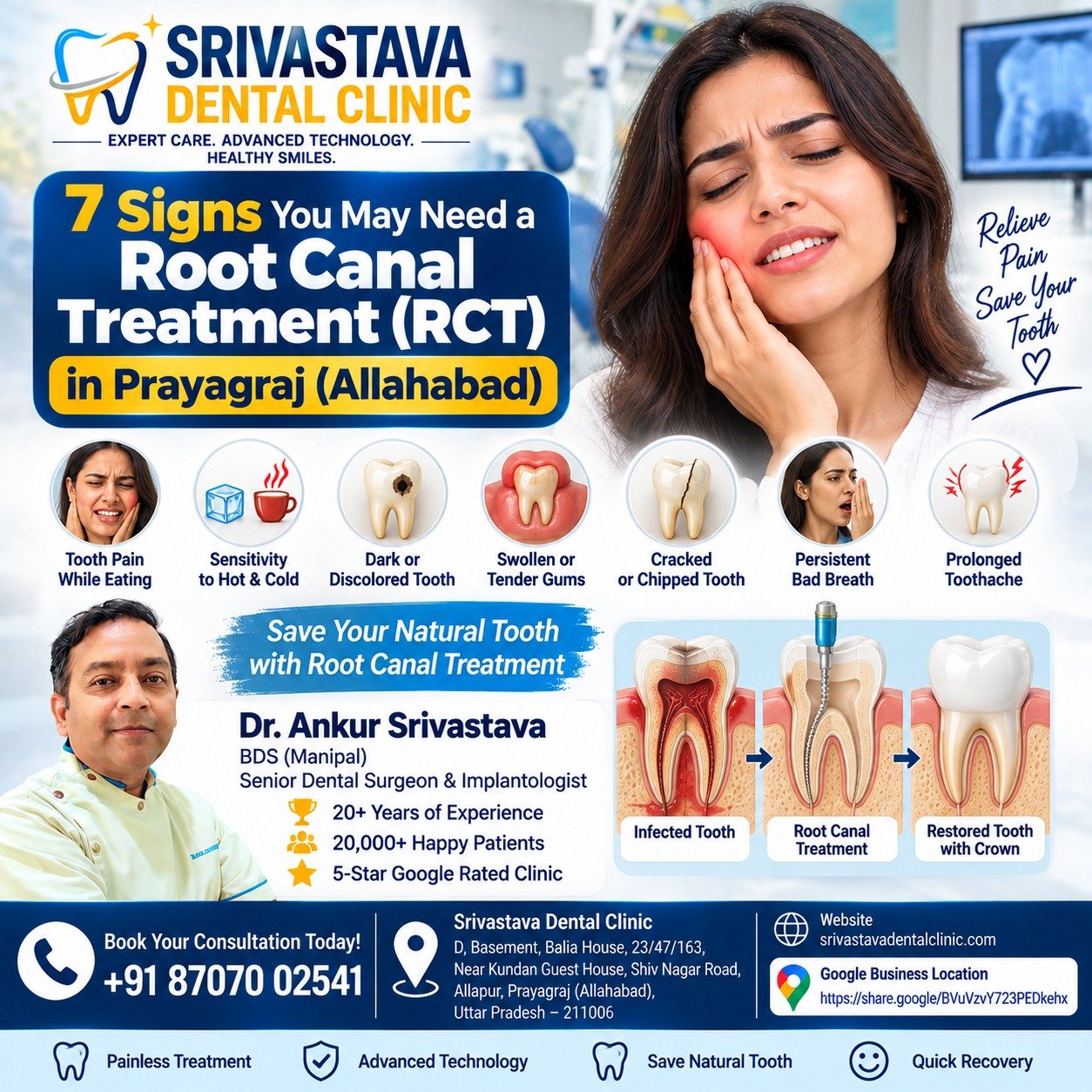
7 signs you may need root canal treatment
The symptoms below deserve attention, particularly when they are persistent, worsening, or occur together. They can also have causes other than pulp infection; an assessment is the safest next step.
Tooth pain when chewing or biting
Pain that becomes sharper when you bite on food, press the tooth, or release your bite deserves an examination. It may come from a deep cavity, a damaged filling, a crack, or inflammation around a tooth's root. If the pulp inside the tooth is badly inflamed or infected, root canal treatment may be one way to preserve it.
Sensitivity to hot or cold that lingers
Brief sensitivity does not automatically mean an infected tooth. However, pain that continues after a hot tea or cold drink has been removed can be a warning sign of more serious pulp inflammation. The duration and pattern matter, so tell your dentist whether the discomfort lasts seconds or much longer.
A tooth that looks darker or discoloured
A tooth that changes to grey, brown, or unusually dark shades—especially after an injury—may need assessment. Discolouration can have several causes, including staining or changes within the tooth. Examination and dental imaging help establish whether the inner pulp is affected.
Swollen, red, or tender gums
Localised swelling, tenderness, or a small pimple-like bump near a tooth may be linked to an infection around the root. A dental abscess can sometimes drain and temporarily feel less painful, but that does not mean the infection has resolved. Prompt dental assessment is important.
A cracked, chipped, or badly decayed tooth
A fracture or deep cavity can allow bacteria to reach the tooth's pulp. Not every damaged tooth needs root canal treatment—some are managed with a filling, crown, or other restoration—but a deep crack or decay extending to the pulp can change the treatment plan.
Persistent bad taste or bad breath with dental symptoms
Ongoing bad breath alone is not proof that you need RCT. It may relate to the tongue, gums, dry mouth, or other causes. But a bad taste or drainage together with localised toothache, swelling, or a gum bump can suggest an infection that should be checked.
Toothache that persists, throbs, or wakes you up
A deep, spontaneous ache, pain that returns repeatedly, or toothache that disrupts sleep warrants prompt assessment. Pain can also originate from a crack, gums, clenching, or a neighbouring tooth. Importantly, a severely damaged or non-vital pulp sometimes causes little or no pain, so an examination matters more than any single symptom.
For a more detailed overview of the service itself, visit the clinic's root canal treatment (RCT) service page in Allahabad / Prayagraj.
Know when it is urgent
When should you see a dentist for tooth pain?
Arrange a dental assessment promptly if toothache continues beyond a day or two, affects sleep or eating, recurs frequently, or occurs with a cracked tooth, swollen gum, fever, or a bad taste. An abscess needs urgent dental care because it generally does not disappear without treatment.
Urgent warning: swelling with breathing or swallowing problems
Seek emergency medical help immediately if swelling in your mouth, face, or neck makes it difficult to breathe, swallow, or speak; if swelling involves the eye; or if there is rapidly spreading swelling. Do not wait for a routine clinic appointment in these situations.
While waiting for your dental appointment, avoid biting on the affected tooth, choose softer foods, maintain gentle oral hygiene, and consider an over-the-counter pain reliever only if it is safe for you and used according to its label or professional advice. Home remedies do not remove an infection within a root canal. Never attempt to puncture a swelling yourself.
What to expect
How dentists diagnose and treat an infected tooth
An appointment typically begins by asking about your pain, medical history, and any previous treatment. The dentist checks the tooth and surrounding gums and may use dental radiographs to assess the roots and supporting bone. The results help distinguish between reversible sensitivity, severe pulp inflammation, a dead pulp, a cracked tooth, and gum-related disease.
Examination & diagnosis
Discuss your symptoms and medical history. The dentist examines your tooth and uses relevant tests or X-rays to evaluate the source of pain and whether it is restorable.
Anaesthesia & access
If RCT is indicated, local anaesthesia is generally used. The tooth is isolated and an opening is made to reach the pulp chamber and root canals.
Cleaning & sealing
Damaged pulp is removed. Canals are cleaned, shaped, disinfected, and sealed with suitable filling material to reduce the risk of reinfection.
Final restoration & follow-up
The dentist places a suitable filling or advises a crown where needed. A properly sealed final restoration and follow-up care are important for long-term tooth function.
Is RCT a painful procedure?
Modern local anaesthesia usually makes root canal treatment manageable and comfortable for most patients. Some tenderness or soreness afterwards is possible, particularly when there was an active infection or inflammation. Ask the dentist what discomfort to expect and when to get in touch if symptoms do not improve. No responsible clinician can promise a completely painless outcome for every individual.
Can a root canal be completed in one sitting?
Some straightforward cases can be completed in a single appointment. Others need two or more, depending on the tooth's anatomy, infection, complexity, and the restoration plan. A proper diagnosis—not a one-visit promise—should guide treatment.
Make an informed decision
Root canal vs filling vs extraction: what is different?
Patients often ask if a deep cavity can be fixed with a filling or if extraction would be simpler. The appropriate option depends on how much tooth structure remains, whether the pulp is healthy, and whether the tooth can be restored.
| Treatment | When it may be considered | Important consideration |
|---|---|---|
| Dental filling | A cavity or defect that can be repaired while the pulp remains healthy or recoverable. | It cannot resolve established infection within the pulp. |
| Root canal + restoration | Irreversibly inflamed or infected pulp in a tooth that can be saved. | A good final filling or crown and continued care are essential. |
| Tooth extraction | A tooth too damaged to restore or with another condition making preservation unsuitable. | Replacement options, bite function, and total cost should be discussed. |
Aftercare: protect your treated tooth
- Do not eat until local anaesthesia has worn off, to avoid biting your cheek or tongue.
- Avoid chewing hard foods on a tooth with a temporary restoration.
- Brush twice daily with fluoride toothpaste and keep the area clean, following your dentist's instructions.
- Complete any recommended crown or permanent restoration without unnecessary delay.
- Return for scheduled follow-up, and seek advice if pain worsens or swelling develops.
What determines root canal treatment cost in Prayagraj?
Price varies by whether the tooth is a front tooth, premolar, or molar; how many canals are present; the extent of infection; difficulty of the case; and the need for X-rays, retreatment, or a crown. Instead of publishing an unverified fixed price, request an itemised estimate after the dentist examines your tooth. Ask whether the quoted amount includes the final restoration and follow-up.
It is also reasonable to ask about the likely benefits, limitations, and prognosis for your particular tooth. In complicated cases, your dentist may recommend further assessment or referral to an endodontist, a dentist with advanced training in root canal procedures.
Local dental consultation
Root canal consultation at Srivastava Dental Clinic, Allahpur
Residents of Allahpur, Shiv Nagar, and neighbouring areas of Prayagraj / Allahabad can arrange an assessment at Srivastava Dental Clinic for dental pain, suspected infection, and treatment planning. The aim of an initial visit is to understand the cause and discuss tooth-preserving options when clinically suitable.
Dr. Ankur Srivastava
BDS (Manipal) • Senior Dental Surgeon & Implantologist
The clinic's website describes more than 20 years of experience. Patient-specific recommendations should be based on a professional dental examination and informed consent.
Editorial transparency: This educational article is prepared for Srivastava Dental Clinic. It should be clinically checked by the treating dentist before publication; no medical-review claim is made here.
Clinic address & appointments
Srivastava Dental Clinic
D, Basement, Balia House, 23/47/163, Shiv Nagar Rd, near Kundan Guest House, Shiv Nagar, Allahpur, Prayagraj, Uttar Pradesh 211006
Email: ankurluvmoney@gmail.com
Website: srivastavadentalclinic.com
Frequently asked questions
14 FAQs about root canal treatment in Prayagraj
These are general education answers. A dentist must confirm whether root canal treatment is necessary and suitable for your specific tooth.
01What are the early signs that I might need root canal treatment?
02Does every painful tooth need a root canal?
03Can a tooth need RCT even if there is no pain?
04Is root canal treatment painful?
05How many appointments does root canal treatment take?
06Do I need a dental crown after a root canal?
07Can antibiotics cure an infected tooth without RCT?
08What happens if I delay treatment for a dental abscess?
09Can a root canal save a cracked tooth?
10How long does a root-canal-treated tooth last?
11How much does RCT cost in Prayagraj?
12Can I eat after root canal treatment?
13When should I return to the dentist after RCT?
14Where can I consult a dentist for RCT in Allahpur, Prayagraj?
Evidence & patient safety
Medical information sources
This article draws on patient information from established dental and public-health organisations. The links below help readers check the general medical guidance; local diagnosis and treatment are individual decisions.
- NHS – Root canal treatment: indications, procedure and recovery
- American Association of Endodontists – Understanding tooth pain and sensitivity
- American Association of Endodontists – Root canal treatment explained
- NHS – Dental abscess and emergency warning signs
Medical disclaimer: This is general educational information, not a diagnosis or substitute for professional dental assessment. Symptoms may overlap with other conditions. If you develop rapid swelling or difficulty breathing, speaking, or swallowing, seek emergency medical care immediately.

